|
Page2.
Click the Photos for a bigger image. The crash was found two days later at 5 o'clock in the afternoon when Sergeant Pridgeon, an RAF cypher clerk, and his girl friend came upon the wreckage of a Skytrain whilst out walking. He knew of the Lancaster bomber that had crashed at some point on the mountaintop they were on, just nine weeks earlier, and he thought that he had come across the scene of the Lancaster bomber wreck. It was only when he came upon the dead bodies of the crew that he realized that he had come across a new crash scene. It appears that the Skytrain hit the high ground, when the hills were shrouded in low cloud as they so often are. When I was at the site in May 2003 there was a plastic Memorial plaque, which was placed there during 2002 by the brother and 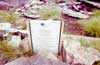 sister
in law of the co-pilot First Lieutenant Earl W. Burns, Glen and Elsie
Burns when they visited the site both aged 69 years. Unfortunately this
plaque has now disappeared, probably due to high winds. To continue the
walk, follow a grassy path which contours in a Northeasterly direction
along the base of James's Thorn, until you arrive at the saddle between
James's Thorn and Lower Shelf Stones, where you pick up a path which crosses
the peat haggs and heads in the direction of Lower Shelf Stones. From
Lower Shelf Stones walk along the top of the crags until you reach the
trig point on Higher Shelf Stones. At the trig point set your compass
to 60 degrees and keep walking for about 250 yards, when you will come
over a low hill and find the wreckage of the Superfortress scattered about
the clough before you. sister
in law of the co-pilot First Lieutenant Earl W. Burns, Glen and Elsie
Burns when they visited the site both aged 69 years. Unfortunately this
plaque has now disappeared, probably due to high winds. To continue the
walk, follow a grassy path which contours in a Northeasterly direction
along the base of James's Thorn, until you arrive at the saddle between
James's Thorn and Lower Shelf Stones, where you pick up a path which crosses
the peat haggs and heads in the direction of Lower Shelf Stones. From
Lower Shelf Stones walk along the top of the crags until you reach the
trig point on Higher Shelf Stones. At the trig point set your compass
to 60 degrees and keep walking for about 250 yards, when you will come
over a low hill and find the wreckage of the Superfortress scattered about
the clough before you. Superfortress B 29 It was only a twenty five minute trip for a B-29 from Scampton in Lincolnshire to Burtonwood USAF base near Warrington, when the pilot Captain Landon P. Tanner took off on the morning of 3rd November 1948, at around 10.15. His crew for the trip consisting of co-pilot, Captain Harry Stroud; engineer, Technical Sergeant Ralph Fields; navigator, Sergeant Charles  Wilbanks;
radio operator, Staff Sergeant Gene A. Gartner; radar operator, David
D. Moore; camera crew, Technical Segeant Saul R. Banks, Sergeant Donald
R. Abrogast, Sergeant Robert I. Doyle and Private First Class William
M. Burrows. Two other crew members were Corporal M. Franssen and Corporal
George Ingram. Acting as photographic advisor was Captain Howard Keel
of the 4201st. When Over Exposed failed to arrive at Burtonwood an air
search was initiated and during that early wintery afternoon blazing wreckage
was spotted high on the moors near Higher Shelf Stones. By chance members
of the Harpur Hill RAF Mountain Rescue Unit were just finishing an exercise
two and a half miles away, so they quickly made their way to the scene
of the crash. Several bodies lay scattered around the blazing twisted
metal, it was obvious that there was nothing that they could do for them. Wilbanks;
radio operator, Staff Sergeant Gene A. Gartner; radar operator, David
D. Moore; camera crew, Technical Segeant Saul R. Banks, Sergeant Donald
R. Abrogast, Sergeant Robert I. Doyle and Private First Class William
M. Burrows. Two other crew members were Corporal M. Franssen and Corporal
George Ingram. Acting as photographic advisor was Captain Howard Keel
of the 4201st. When Over Exposed failed to arrive at Burtonwood an air
search was initiated and during that early wintery afternoon blazing wreckage
was spotted high on the moors near Higher Shelf Stones. By chance members
of the Harpur Hill RAF Mountain Rescue Unit were just finishing an exercise
two and a half miles away, so they quickly made their way to the scene
of the crash. Several bodies lay scattered around the blazing twisted
metal, it was obvious that there was nothing that they could do for them.  |